
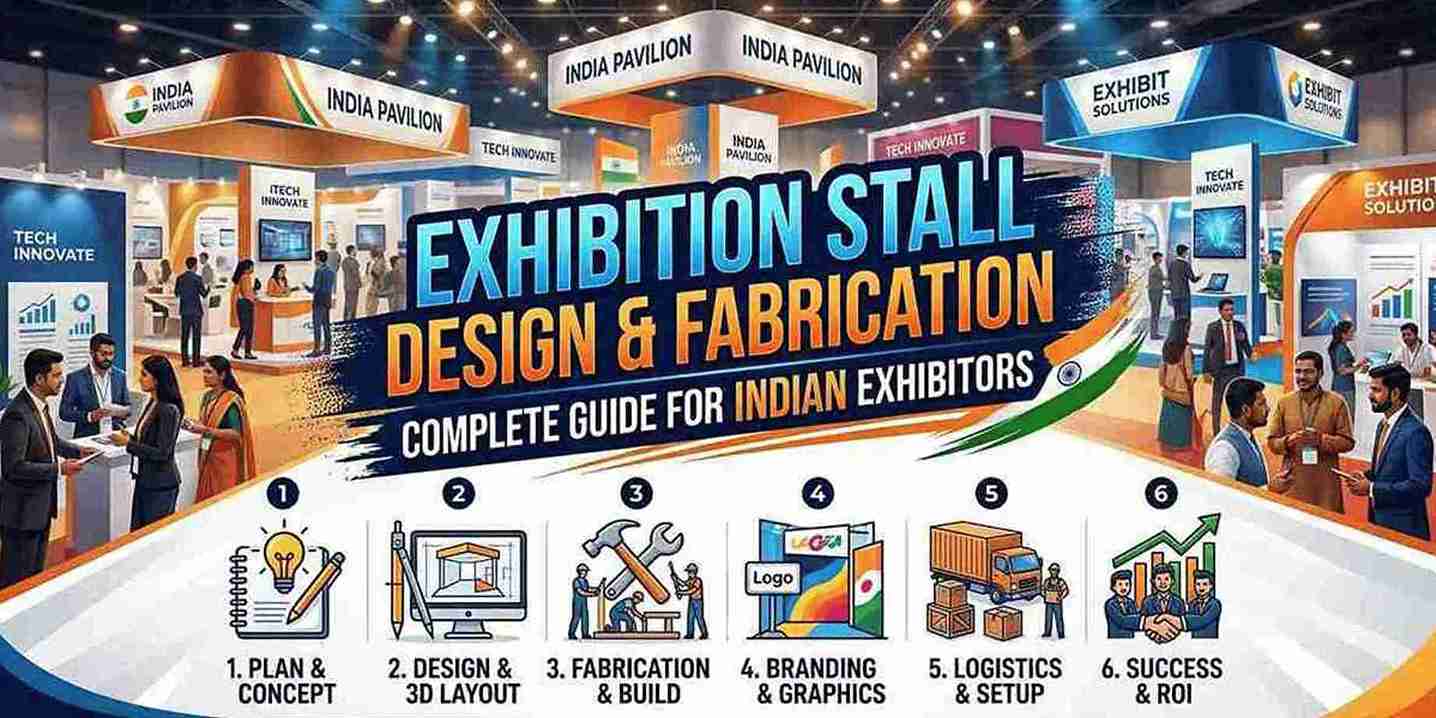
Exhibitions and trade shows provide businesses with an excellent opportunity to showcase their products, connect with potential customers, build brand awareness, and understand industry trends. However, with numerous companies competing for attention at the same venue, simply participating in an exhibition is not enough. A professionally planned exhibition stall can help a brand attract visitors and communicate its message effectively.
Exhibition stall design and fabrication involves much more than constructing a temporary structure. It combines creative design, branding, space planning, materials, lighting, technology, and practical execution to create an engaging environment for visitors.
What Is Exhibition Stall Design and Fabrication?
Exhibition stall design is the creative planning of a booth or stall according to the available exhibition space, brand identity, products, and business objectives. It determines the overall appearance, layout, visitor flow, branding elements, product displays, meeting areas, storage, lighting, and technology requirements.
Fabrication is the process of turning that design into a physical exhibition structure. It can include carpentry, metalwork, acrylic and glass elements, printed graphics, flooring, electrical installations, lighting, furniture, signage, and other display components.
The combination of good design and precise fabrication helps ensure that the final stall is both visually appealing and functional.
Read Related – Global Event Company India: Memorable Experiences for Businesses
Why Is Professional Stall Design Important?
An exhibition environment is usually busy, with several brands displaying their products close to one another. A thoughtfully designed stall can create a clear visual identity and make it easier for visitors to understand what a company offers.
A well-planned stall should consider:
- Brand colours and visual identity
- Product and service presentation
- Visitor movement
- Lighting and visibility
- Reception and meeting areas
- Storage requirements
- Digital displays and interactive elements
- Available exhibition space
- Event-specific guidelines
The objective should not be to fill every part of the space with graphics or decorative elements. Instead, the design should maintain a balance between branding, accessibility, aesthetics, and functionality.
Types of Exhibition Stall Designs
Different exhibitions require different booth formats. The most suitable design depends on the location and size of the allocated space.
Linear stalls are generally positioned against a wall and are suitable for compact displays. Corner stalls have two open sides, providing greater visibility and accessibility. Peninsula stalls usually have three open sides, while island stalls are open from all directions and can create a strong visual presence.
For larger exhibition areas, businesses may also consider double-decker structures, experience zones, private meeting rooms, product demonstration areas, or interactive installations.
Custom Booth Designing for Stronger Brand Identity
Custom booth designing gives businesses greater flexibility to create an exhibition environment around their specific brand and objectives. Instead of using a standard layout, the entire booth can be developed according to the company’s requirements.
A custom booth may include branded reception counters, product showcases, LED screens, suspended signage, backlit graphics, meeting cabins, demonstration areas, storage units, and creative architectural elements.
For companies participating in important trade shows, custom designing can also help establish a consistent connection between the exhibition booth and the company’s existing branding across websites, offices, packaging, and marketing materials.
Materials Used in Booth Fabrication
Material selection plays an important role in the appearance, durability, and practicality of an exhibition stall. Commonly used materials include MDF, plywood, aluminium profiles, acrylic, glass, fabric graphics, vinyl, laminates, and various printed panels.
The appropriate material depends on the design concept, booth size, exhibition requirements, transportation considerations, installation time, and budget.
Lighting is another important component. Spotlights, LED strips, backlit panels, hanging lights, and illuminated signage can be used to highlight products and important branding areas. However, lighting should support the design rather than create excessive visual clutter.
The Exhibition Stall Fabrication Process
A typical booth project starts with understanding the exhibitor’s requirements and reviewing the available floor space. The design team then develops a concept based on the brand, products, target audience, and exhibition objectives.
The process generally includes:
- Requirement analysis and space planning
- Concept development
- 3D booth design and visualisation
- Material and graphic selection
- Structural fabrication
- Printing and branding production
- Transportation to the venue
- On-site installation
- Final inspection and handover
- Dismantling after the exhibition
Proper coordination between designers, fabricators, electricians, printers, logistics teams, and the exhibition organiser is essential for smooth execution.
How Much Does Exhibition Stall Fabrication Cost?
The cost of an exhibition stall can vary considerably depending on several factors. These include booth size, design complexity, materials, graphics, flooring, furniture, lighting, technology, location, transportation, installation, and dismantling requirements.
A simple modular stall may require a different investment compared with a fully customised booth featuring premium finishes, large LED screens, meeting rooms, or complex architectural structures.
Therefore, exhibitors should evaluate quotations based on the complete scope of work rather than comparing only the basic fabrication price.
Read Related – Interior Design Styles – Transforming Spaces with Creative Booth Design Concepts
How to Plan Your Exhibition Stall Effectively
Businesses should begin planning their booth well before the exhibition date. Early planning provides sufficient time for design revisions, approvals, material procurement, printing, fabrication, logistics, and venue installation.
It is also useful to establish clear objectives. For example, one company may want to generate product enquiries, while another may focus on demonstrations, distributor meetings, brand awareness, or networking.
The booth layout should support these objectives while making it easy for visitors to enter, explore, interact, and communicate with the brand representatives.
Conclusion
Effective exhibition stall design and fabrication combines creativity with careful planning and practical execution. From selecting the right layout and materials to integrating branding, lighting, technology, and visitor-friendly spaces, every element contributes to the overall exhibition experience.
For Indian exhibitors, custom booth designing and booth fabrication can provide an opportunity to create a distinctive brand environment that reflects business identity and exhibition goals. Whether the requirement is a compact modular stall or a large customised exhibition booth, thoughtful design and professional execution can make the space more functional, attractive, and memorable.
Ultimately, a successful exhibition stall is not simply a structure at an event. It is a physical representation of the brand and an environment designed to encourage meaningful interaction with visitors.